
Supply Chains
This unit takes students inside the global systems that produce the objects they use every day. Starting with a single product — a coffee cup, a pair of trainers, a mobile phone — students work backwards through the production process to understand who is involved at each stage and what conditions they work under.
The unit asks students to think about value: who creates it, who captures it, and what determines how it is shared. It introduces concepts from economics, geography, and ethics in a way that feels grounded rather than theoretical.

Duration
4-6 sessions
Level
ESO 3-4 / Bachillerato
Subjects
Geography, Economics, Ethics
Materials
Worksheets, slides, guides

Ecological Footprint
The ecological footprint unit moves from the abstract — "we're consuming too much" — to the concrete: how much land and water does a particular lifestyle actually require? Students calculate their own footprints and compare them with global averages and planetary limits.
Beyond individual calculation, the unit explores structural factors: how urban design, food systems, and energy infrastructure shape collective footprints. Students examine scenarios where different choices produce significantly different outcomes, and they discuss what changes at the individual, community, and policy levels.
Duration
3-5 sessions
Level
ESO 2-4 / Bachillerato
Subjects
Biology, Geography, Maths
Materials
Calculator tools, scenarios
Responsible Labeling
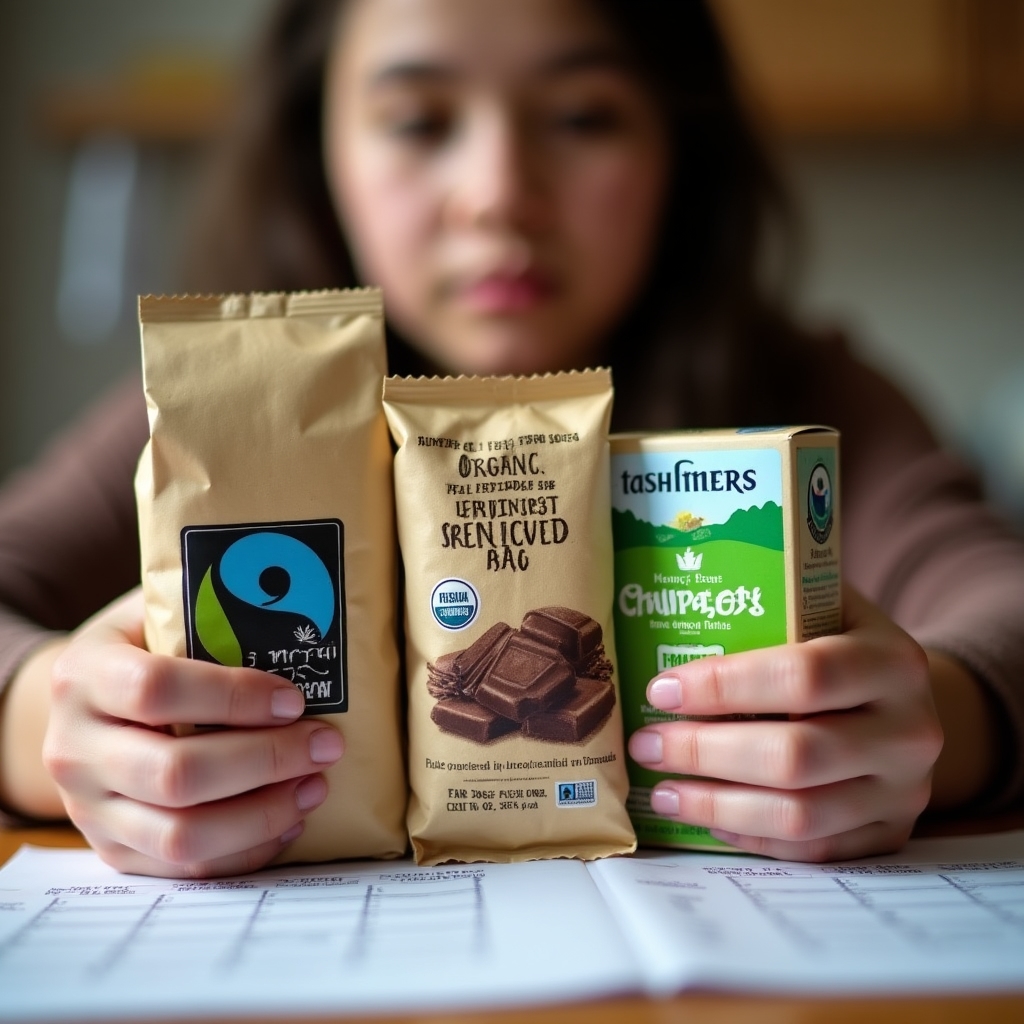
Labels and certifications are a point of contact between consumers and the systems behind products. This unit teaches students to read them critically — not to dismiss them, but to understand what they actually mean, what they require, and what they leave out.
Students compare different certification schemes — fair trade, organic, Rainforest Alliance, and others — looking at their governance structures, auditing processes, and real-world effects on producers. A creative design exercise asks students to create their own certification scheme, forcing them to navigate genuine trade-offs.
Duration
3-4 sessions
Level
ESO 3-4 / Bachillerato
Subjects
Ethics, Economics, Language
Materials
Comparison guides, design brief

Consumption Alternatives
This unit moves beyond critique to explore what different systems of production and consumption actually look like. Students examine cooperative models, circular economy principles, repair culture, local food networks, and community-supported agriculture.
The goal is not to present any single alternative as the answer, but to help students see that the current system is one design among many possible designs. Understanding alternatives is the first step toward informed participation in debates about how economies should work.
Duration
4-5 sessions
Level
ESO 4 / Bachillerato
Subjects
Economics, Social Sciences
Materials
Case studies, debate guides
Download the full curriculum pack
All four units are available as downloadable PDF packs for teachers. Lesson plans, student worksheets, and assessment guides included.
View All Materials